Before this course, I admit that as a first grade literacy teacher, my goal was for my students to be able to understand, verbalize and make connections to texts we read - to go beyond just learning to read, but also reading to learn from all types of books (fiction, non-fiction, informational, biography, etc.) However, I did not looking critically at the books I was choosing to educate my students.
Critical literacy means creating spaces in my classroom for books that force children to think not only about the story itself but also the internal structures that allow students understand and make connections to the text. Students need to be aware of the role of different characters, how an author's point of view influences the story, how different people of race and religion are represented in sets of text (either found in school, in the media, in movies, etc.)
At first, I was a bit disheartened in my own teaching because many of the books I had been choosing had not been especially good examples of diverse and unbiased literature. But critical literacy has helped me to understand that children need to be exposed to all forms of text - but what is important is how we guide them to interact with the text as readers and critical thinkers.
Wednesday, April 23, 2008

Tuesday, April 22, 2008
Research at a Local Bookstore
For my research I went to the B.Dalton Bookstore at Ballston Common Mall. It is part of a small chain of bookstores, mostly found in malls, that is now owned by Barnes and Noble. Ballston is a neighborhood of Arlington, VA located just west of Washington, DC. The population of Ballston is mostly young working singles near the center of the neighborhood and families (primarily white and Hispanic) a little further out from the center of town.
When observing in the bookstore, there were not a large number of books that represented diversity. There were some books that portrayed diversity in characters, or directly such as in Is there really a Human Race? by Jamie Lee Curtis, however I found that many of the books represented characters in very stereotypical way. For example, many of the children's books in the Baron's Books series, which address specific phonics sounds, had token African American or Asian characters.
The children's section is located in the back, left section of the store. There are about 4, 5 foot bookshelves arranged by gender and topic. On the main wall there were many well known book titles such as Mo Williams The Pidgeon Finds a Hot Dog and many Dr. Seuess titles. There were not many books titles that addressed more critical social issues, such as might be found in a bookstore like Busboys and Poets.
As noted for my post on the library, there are many Hispanic residents in Ballston, so it was good to see books in Spanish quite prominently displayed in the store. However, they were mostly titles like Harry Potter and Curious George translated into Spanish. This does allow these students access to the books, however there is still a cultural divide when these books place readers in cultures that are not like their own. I would have liked to see more titles by Spanish authors that readers could make more personal connections to.
When observing in the bookstore, there were not a large number of books that represented diversity. There were some books that portrayed diversity in characters, or directly such as in Is there really a Human Race? by Jamie Lee Curtis, however I found that many of the books represented characters in very stereotypical way. For example, many of the children's books in the Baron's Books series, which address specific phonics sounds, had token African American or Asian characters.
The children's section is located in the back, left section of the store. There are about 4, 5 foot bookshelves arranged by gender and topic. On the main wall there were many well known book titles such as Mo Williams The Pidgeon Finds a Hot Dog and many Dr. Seuess titles. There were not many books titles that addressed more critical social issues, such as might be found in a bookstore like Busboys and Poets.
As noted for my post on the library, there are many Hispanic residents in Ballston, so it was good to see books in Spanish quite prominently displayed in the store. However, they were mostly titles like Harry Potter and Curious George translated into Spanish. This does allow these students access to the books, however there is still a cultural divide when these books place readers in cultures that are not like their own. I would have liked to see more titles by Spanish authors that readers could make more personal connections to.
Research in a Local Library
For my observation I went to the Central Branch of the Arlington Public Library. It is located in the neighborhood of Ballston, just west of Washington, DC. It is important to note that Arlington has a large number of Hispanic residents. There are many apartment complexes located and a local elementary school just south of the library.
I found some diversity represented in the books that were displayed. When you walk into the library, the kids section is off to the right. On a bookshelf, there are books that have been either recommended by a librarian or have a thematic importance like a holiday that is happening that time of year.
I was happy to see a fair number of Spanish books available in the recommended section, as well as in other sections of the library, such as books on tapes. Some of the titles I found were:
Sol a Sol by Lori Carlson and Emily Lisker
Yum! MmMm! Que Rico!: America's Sproutings by Pat Mora and Rafael Lopez
Many of the books out were poetry books, since the library is celebrating poetry month during the month of April.
While there were a fair number of books for Spanish speaking children, the library lacked books for those of other ethnicities or cultures besides white. Also, even some of the books for Spanish speakers were English books that had been translated or were authored (it seems based on names) not by native Spanish speakers. While the books convey messages about Spanish culture, it does not appear that they stereotype Hispanic children.
The library is fairly close to the Ballston metro but it would be easier for people to access the library if they had a car. However, the Arlington Public Library does have a few branches so that people can access books even if they are not close to a metro or bus stop.
I found some diversity represented in the books that were displayed. When you walk into the library, the kids section is off to the right. On a bookshelf, there are books that have been either recommended by a librarian or have a thematic importance like a holiday that is happening that time of year.
I was happy to see a fair number of Spanish books available in the recommended section, as well as in other sections of the library, such as books on tapes. Some of the titles I found were:
Sol a Sol by Lori Carlson and Emily Lisker
Yum! MmMm! Que Rico!: America's Sproutings by Pat Mora and Rafael Lopez
Many of the books out were poetry books, since the library is celebrating poetry month during the month of April.
While there were a fair number of books for Spanish speaking children, the library lacked books for those of other ethnicities or cultures besides white. Also, even some of the books for Spanish speakers were English books that had been translated or were authored (it seems based on names) not by native Spanish speakers. While the books convey messages about Spanish culture, it does not appear that they stereotype Hispanic children.
The library is fairly close to the Ballston metro but it would be easier for people to access the library if they had a car. However, the Arlington Public Library does have a few branches so that people can access books even if they are not close to a metro or bus stop.
Wednesday, March 19, 2008
Interview with a Classroom Teacher
I interviewed a 6th grade science and social studies teacher at my school who, while he does not use literature everyday in his class has an unique perspective on how and why it should be used even in subject matter courses.
What role does literature play in the classroom curriculum?
I am a social studies and science teacher so as far as social studies goes, I think there is a difference between the ideal role and the actual. Ideally, literature is one of the ideal ways to teach social studies. In terms of science, it is useful as well but less applicable. In reality however, I am not able to use literature because I do have literature that ties into our standards but I do try to tie in what they are currently studying in English.
What kinds of books are chosen? Why and how?
For social studies, I would ideally choose books that specifically tie into the issues we are studying. For example, when teaching world geometry I could tie in fables from different countries we are studying to give students an idea of the cultural differences that exist between themselves and students in different countries.
Who decides on what books are used in the classroom?
I do. There is little to no pressure to use literature or books for teaching or reinforcing science and social studies at my school. While I would like to choose and tie in more books resources and time restraints make that difficult.
What is your theoretical perspective on teaching or specifically on using children's literature in the curriculum?
I think that stories are a fundamental part of human culture and all children no matter how disconnected they are from the subject matter can connect to good stories. For me it is more about incorporating good stories into the curriculum then finding a story for every part (or every standard/strand/unit) in the curriculum.
What role does literature play in the classroom curriculum?
I am a social studies and science teacher so as far as social studies goes, I think there is a difference between the ideal role and the actual. Ideally, literature is one of the ideal ways to teach social studies. In terms of science, it is useful as well but less applicable. In reality however, I am not able to use literature because I do have literature that ties into our standards but I do try to tie in what they are currently studying in English.
What kinds of books are chosen? Why and how?
For social studies, I would ideally choose books that specifically tie into the issues we are studying. For example, when teaching world geometry I could tie in fables from different countries we are studying to give students an idea of the cultural differences that exist between themselves and students in different countries.
Who decides on what books are used in the classroom?
I do. There is little to no pressure to use literature or books for teaching or reinforcing science and social studies at my school. While I would like to choose and tie in more books resources and time restraints make that difficult.
What is your theoretical perspective on teaching or specifically on using children's literature in the curriculum?
I think that stories are a fundamental part of human culture and all children no matter how disconnected they are from the subject matter can connect to good stories. For me it is more about incorporating good stories into the curriculum then finding a story for every part (or every standard/strand/unit) in the curriculum.
Mini Research 4 and 5 - Children's Literature Websites and Media Research
Here are the 4 websites I found when looking on-line.
1) Vandergrift's Children's Literature Page
http://www.scils.rutgers.edu/~kvander/ChildrenLit/index.html
This website was created by a professor at Rutgers University. It offers a wealth of questions and resources about children's literature. It even includes issues of race, gender and ethnicity, which is especially appealing for a critical literacy perspective.
2) Database of Award-Winning Children's Literature
http://www.dawcl.com/
This data base allows you to search for books who have won one or more of 78 listed awards from six different countries (USA, Canada, Australia, New Zealand, England and Ireland). The data base allows you to search for books according to parameters such as age of reader, setting, gender/ethnicity of protagonist, etc.
3) Fairrosa Cyber Library of Children's Literature
http://www.fairrosa.info/
This website is broken into five major parts: archive, reference shelf, reading room, showcase and information. The archive section has discussions on various topics in children's literature available for reading. The reading room had a variety of different types of texts available online, from magazines to full on-line versions of The Secret Garden. The showcase focuses on one specific topic and currently the topic is dragons in children's lit. Finally, the information section offers a place for people to contact the creator and the purpose of the website.
4) Library Things - Group Children's Literature
http://www.librarything.com/groups/childrensliterature
This is a forum where anyone can start or continue discussions related to children's literature. Some of the recent topics were the NEA's top five list of children's books, books that make you cry, and adult books in the format of children's story books.
When completing my media research I found a video that showcases "political bedtime stories." These are books being created from a partisan standpoint but in the format of a children's stories. While the publishers and author's believe children should be exposed to these views and the parents should have the choice of what to read to their children, a college professor offers her input that the books just aren't very well written. Check out the video, it's pretty good, if only to see the character of "Congresswoman Clunkton" who looks strikingly like.....well you'll be able to tell. :)
http://www.cnn.com/video/#/video/politics/2007/07/31/rowlands.bedtime.story.cnn?iref=videosearch
1) Vandergrift's Children's Literature Page
http://www.scils.rutgers.edu/~kvander/ChildrenLit/index.html
This website was created by a professor at Rutgers University. It offers a wealth of questions and resources about children's literature. It even includes issues of race, gender and ethnicity, which is especially appealing for a critical literacy perspective.
2) Database of Award-Winning Children's Literature
http://www.dawcl.com/
This data base allows you to search for books who have won one or more of 78 listed awards from six different countries (USA, Canada, Australia, New Zealand, England and Ireland). The data base allows you to search for books according to parameters such as age of reader, setting, gender/ethnicity of protagonist, etc.
3) Fairrosa Cyber Library of Children's Literature
http://www.fairrosa.info/
This website is broken into five major parts: archive, reference shelf, reading room, showcase and information. The archive section has discussions on various topics in children's literature available for reading. The reading room had a variety of different types of texts available online, from magazines to full on-line versions of The Secret Garden. The showcase focuses on one specific topic and currently the topic is dragons in children's lit. Finally, the information section offers a place for people to contact the creator and the purpose of the website.
4) Library Things - Group Children's Literature
http://www.librarything.com/groups/childrensliterature
This is a forum where anyone can start or continue discussions related to children's literature. Some of the recent topics were the NEA's top five list of children's books, books that make you cry, and adult books in the format of children's story books.
When completing my media research I found a video that showcases "political bedtime stories." These are books being created from a partisan standpoint but in the format of a children's stories. While the publishers and author's believe children should be exposed to these views and the parents should have the choice of what to read to their children, a college professor offers her input that the books just aren't very well written. Check out the video, it's pretty good, if only to see the character of "Congresswoman Clunkton" who looks strikingly like.....well you'll be able to tell. :)
http://www.cnn.com/video/#/video/politics/2007/07/31/rowlands.bedtime.story.cnn?iref=videosearch
Wednesday, February 20, 2008
Text Set Beginnings
Why Mosquitoes Buzz in People's Ears
by Verna Aardema with pictures by Leo and Diane Dillon

For my text set, I want to begin with the book Why Mosquitoes Buzz in People's Ears. It is an African tale that deals with the consequences of lying among a group of animals in the forest. The illustrations in the story are striking and provide parallels to the feelings of the animals at different points of the story. I would love to use this story with my students to deal with lying. My students have no problem telling lies, even when a teacher sees them doing something wrong. I find this story very compelling with serious consequences to show them that their actions have real consequences.
Because the illustrations are so striking and original in this book, I would pick the National Museum of African Art in Washington, DC. I think that images and masks found at the museum could serve as an interesting comparison to the illustrations. Also, looking at how African artists use color to evoke emotion would strengthen the connection.
Because the illustrations are so striking and original in this book, I would pick the National Museum of African Art in Washington, DC. I think that images and masks found at the museum could serve as an interesting comparison to the illustrations. Also, looking at how African artists use color to evoke emotion would strengthen the connection.
Self as the Informant
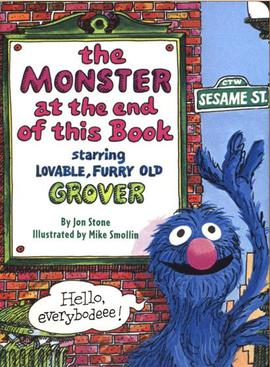
The first book I have specific memories of is The Monster at the End of this Book by Jon Stone. When I was about 3 years old, I had my mother read this story every night. The story is a cautionary tale where you are guided by the narrator, Grover. He instructs you on each page, to NOT turn the page because it will get you closer to the monster at the end of the book. He takes drastic measures to keep you from turning the page, including using bricks and mortar, and nailing boards to the page. I remember, even by the 50th time my mother had read this book, getting nervous each time we would turn the page and get a step closer to the monster. In the end, the monster is actually Grover, the lovable narrator who has been with you the whole time. My mother did a fabulous job engaging me in the book by reading with excitement and fear and also by talking to me after about confronting things that scare me because you never know what will happen.

Despite being and avid reader from the time I could pick up a book, it wasn't until I was 12 years old that I really became lost in a book. In sixth grade we were assigned Walk Two Moons by Sharon Creech. It is a complex story about a girl name Sal who is trying to come to grips with not only her mother's disappearance but also her new life and relationships in the place where she and her father have moved. As an adolescent, I remember being surprised and amazed at how the language and the world created by the author could have such a significant impact on the reader. While I had not experienced the hardships that Sal had in her life, I connected to the adolescent feeling of confusion and the need for answers.

Despite being and avid reader from the time I could pick up a book, it wasn't until I was 12 years old that I really became lost in a book. In sixth grade we were assigned Walk Two Moons by Sharon Creech. It is a complex story about a girl name Sal who is trying to come to grips with not only her mother's disappearance but also her new life and relationships in the place where she and her father have moved. As an adolescent, I remember being surprised and amazed at how the language and the world created by the author could have such a significant impact on the reader. While I had not experienced the hardships that Sal had in her life, I connected to the adolescent feeling of confusion and the need for answers.
Subscribe to:
Posts (Atom)
+033.jpg)